Practical AI
Using AI Is Easy. Building It Into Your Business Is Harder.
Plenty of businesses are using AI. Far fewer have changed the way they work because of it. The real opportunity begins when AI moves beyond individual prompts and becomes part of better-designed workflows.

Plenty of businesses are using AI. Far fewer have changed the way they work because of it. That distinction may matter more than which AI tools they choose.
AI adoption has happened remarkably quickly. Business owners and their teams are using ChatGPT and other AI tools to draft emails, brainstorm ideas, summarize documents, write marketing copy, research competitors and answer questions. Much of that is genuinely useful. A task that used to take 45 minutes might take 15. A blank page becomes a first draft. Research that once required opening a dozen browser tabs can begin with a conversation.
But there is an important difference between using AI and building AI into the way a business operates. For many businesses, AI is still essentially another tool sitting beside the existing process. It makes individual tasks faster, but the process itself hasn't changed.
The AI Tab Problem
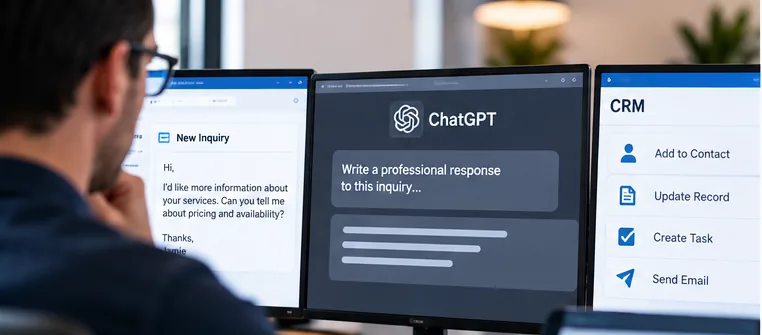
Think about how AI entered most businesses. Someone opened ChatGPT, typed a prompt, copied the answer and pasted it into an email, document, spreadsheet, CRM, social platform or some other system.
That's certainly more efficient than doing everything manually, but look closely at what happened. The person is still moving information between systems, deciding when the next step happens, updating records and handling the follow-up. AI made one part of the task faster without necessarily making the system better.
This is similar to what happens when a business takes a bad paper process and turns it into a spreadsheet. The technology improves part of the experience, but the underlying workflow remains largely unchanged.
The bigger opportunity comes when businesses stop asking "What can I ask AI to do?" and start asking "Where could AI participate in the way this work gets done?"
From Prompts to Workflows
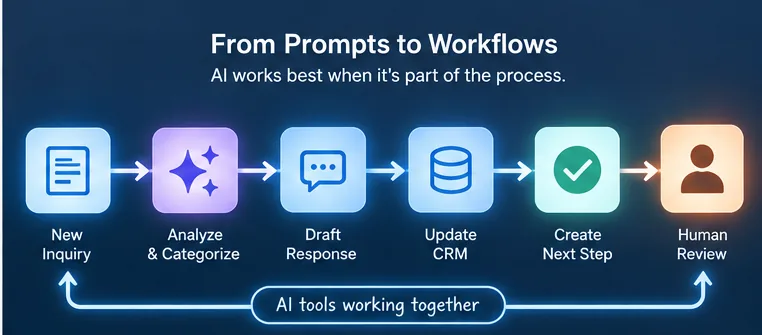
Businesses need to move beyond individual prompts and begin thinking in workflows — what some calls "agentic flows," where AI tools perform different parts of a process and pass work between them.
It's an important distinction because the value isn't necessarily in any one AI action. It's in what happens when AI, automation, existing systems and people work together as part of a better-designed process.
Imagine a service business receiving a new inquiry through its website. In a traditional workflow, someone might:
read the inquiry and determine what the prospect needs;
enter the information into another system;
send an acknowledgment;
assign the inquiry to someone;
research the prospect;
schedule a follow-up; and
prepare information for the eventual conversation.
AI could help write the acknowledgment. That's using AI.
But suppose the inquiry instead enters a workflow where the information is automatically categorized, relevant details are extracted, the appropriate next step is identified, a personalized response is prepared, the CRM is updated and the right person is alerted when human attention is needed. Now AI isn't sitting beside the workflow anymore. It's becoming part of it.
Importantly, the human hasn't disappeared. The human is spending less time moving information around and more time doing the things that actually require judgment, expertise, empathy and decision-making.
That's Where the Economics Start to Change
This is why measuring AI adoption by how many employees use an AI tool can be misleading. Imagine one company with 20 employees regularly using AI to write emails, summarize meetings and create content. Now imagine another company with only five employees using AI, but it has redesigned its lead-intake process so inquiries are automatically categorized, researched, routed and prepared for follow-up.
Which company has adopted AI more deeply?
Probably the second one, because the important metric isn't simply AI usage. It's whether AI improves an economically meaningful part of the business.
That could mean generating more qualified leads, responding to customers faster, reducing administrative work, shortening the time between an inquiry and a sale, improving follow-up, reducing errors or allowing the business to handle more volume without adding the same amount of overhead. Those are business outcomes, and that's ultimately where AI needs to lead.
Don't Automate a Bad Process
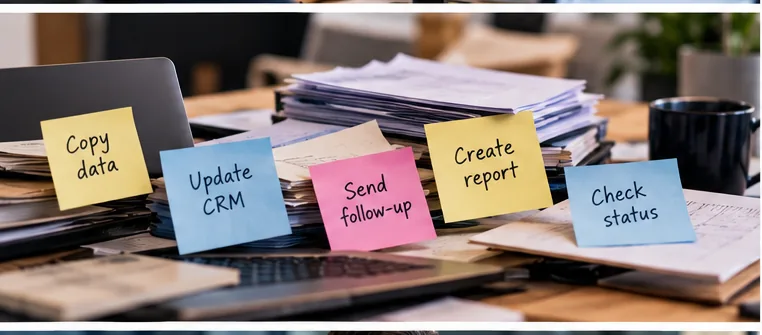
There is a catch: adding AI to a broken workflow doesn't necessarily fix the workflow. Sometimes it just makes the broken workflow move faster.
If information is scattered across spreadsheets, inboxes and disconnected systems, adding an AI tool on top of everything may simply create another layer of complexity. That's why the first question shouldn't be "Where can we add AI?" It should be "How should this work?"
Before choosing the technology, understand the process:
Where does information enter the business?
Where does it go next?
Who needs it?
What decisions have to be made?
Where does work sit waiting?
Where are people copying information from one system into another?
Where are customers waiting unnecessarily?
Where does human judgment genuinely matter?
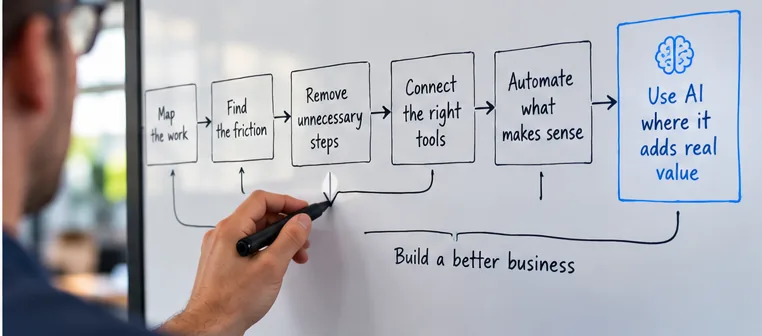
Once you understand the work, you can decide what should be eliminated, simplified, connected or automated — and where AI actually belongs.
That sequence matters because not every automation problem is an AI problem. Sometimes the right answer is a simple integration between two systems. Sometimes it's a traditional automation. Sometimes it's changing a form, eliminating an approval, consolidating two tools or simply stopping a task that no longer serves a purpose.
AI should be part of the solution when it adds something useful, not because every process suddenly needs AI.
Look for the Handoffs
One useful place to start is with handoffs. Every time information moves from one person to another, from one system to another or from one stage of a process to another, there is an opportunity for friction.
Consider a familiar sequence: someone fills out a form, someone else reads it, someone copies the information into a spreadsheet, another person enters it into a CRM, someone sends an email, someone creates a task and somebody remembers to follow up three days later. Individually, none of those steps seems particularly burdensome. Multiply them across hundreds of customers, transactions or requests and they become part of the operating cost of the business.
AI won't necessarily eliminate every step, nor should it. But it can increasingly help businesses interpret information, prepare responses, summarize context, identify patterns, recommend next actions and move routine work forward. Combined with good automation and connected systems, that can fundamentally change how the process operates.
That's much more consequential than generating another piece of marketing copy.
Practical AI Is Usually Less Exciting Than the Demo
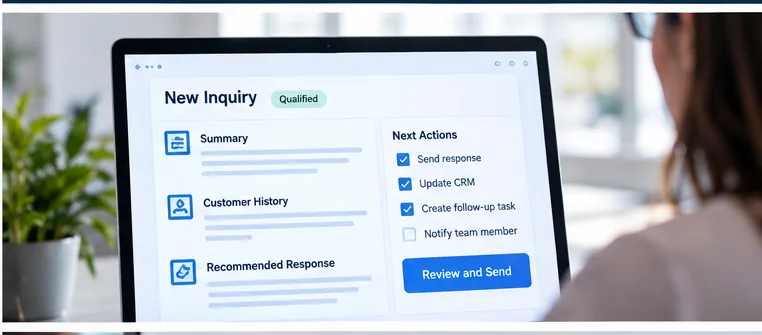
The most valuable AI implementation in a business may not look particularly impressive. It might mean an inquiry arrives already summarized, a salesperson opens a record and immediately sees the relevant history, or a customer receives the right information without waiting until tomorrow morning.
It could be a weekly report that assembles itself instead of consuming two hours every Friday, or a team member who no longer has to enter the same information into three different systems. It might simply mean that when someone needs to make a decision, the information they need is already there.
None of those examples makes for a particularly dramatic AI demonstration. They don't involve a robot taking over a company or an autonomous "AI employee" running an entire department. They simply remove friction from the way real work gets done.
And that can make a much better business.
Start With One Workflow
Businesses don't need an "AI transformation" initiative to begin doing this. A better starting point is to choose one workflow that creates noticeable friction, preferably something that happens frequently and touches revenue, customer experience or a significant amount of staff time.
Map that workflow from beginning to end. Identify what starts the process, what information is required, what happens every time and where the process tends to slow down or break. Pay particular attention to repetitive decisions, manual handoffs, copying and pasting, duplicate data entry and situations where someone has to hunt for information before taking the next step.
Then separate the work into three broad categories:
Work that should disappear. Unnecessary steps, duplicate activities and processes that exist primarily because "we've always done it this way."
Work that technology can handle. Moving data, triggering actions, updating systems, assembling information and other predictable tasks.
Work where people add real value. Judgment, relationships, creativity, negotiation, empathy, exceptions and consequential decisions.
Only then should you ask where AI belongs.
You may discover that you don't need another AI tool at all. You might need a better workflow. And once that workflow makes sense, AI may become one of the pieces that makes it dramatically better.
The Goal Isn't More AI
There's going to be enormous pressure on businesses over the next few years to "use AI." But that shouldn't be the goal. The goal should be to build a better business: one where information moves more easily, customers aren't waiting unnecessarily, employees aren't spending hours on low-value administrative work and systems support the way the organization actually operates.
AI can play a major role in that. It can help interpret information, surface insights, prepare work, communicate at scale and handle activities that previously required significant human effort. But its value should ultimately be measured by what changes in the business, not by how frequently someone opens an AI tool.
If your entire AI strategy consists of giving people access to ChatGPT and encouraging them to write better prompts, you're probably only scratching the surface.
Don't start with the prompt. Start with the work — and then decide what should exist instead.